
European income tax rates are generally higher than those in the United States or United Kingdom, and Germany and Austria are among the countries where some of the steepest rates tend to apply.
Switzerland, on the other hand, is a major exception, and even has a bit of a reputation as an attractive destination for high-earners, in part due to its relatively liberal tax policies.
What this means for employees across the DACH region (which includes Germany, Austria and Switzerland), is that you can expect to pay significantly more tax if you live in Berlin or Vienna than you would on the same income in Zurich.
The numbers
Swiss cities maintain significantly lower income tax rates than those in Germany and Austria.
To give a sense, for a salary of $100,000 per year, a resident of Zug, Switzerland would pay just six percent income tax and be left with about $94,000, according to figures by Patrician.ch.
On the other end of the spectrum, a resident of Vienna, Austria would pay 32 percent income tax and be left with just over $68,000.
Looking at it the other way, a resident of Zug earning $100,000 would owe just $5,998 in income tax each year, whilst a Vienna resident would owe $31,833.
READ ALSO: The tax deadlines Americans in Austria need to know in 2026
With an income tax rate of 29 percent, residents of Berlin, Frankfurt or Munich would owe $29,383 – and take home just over $70,000.
The table below compares the figures for individuals with a higher salary, at $300,000 annually.
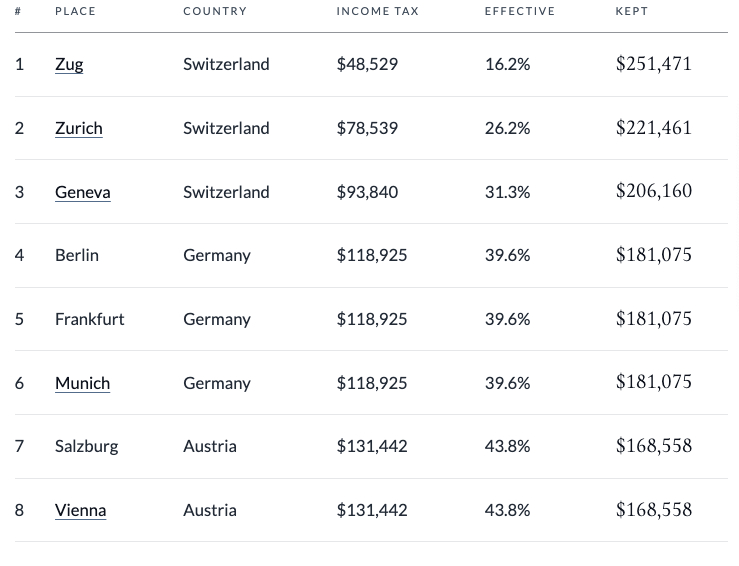
Across all cities listed above, income tax rates tick upward as salaries rise.
For super high earners, bringing in $1,000,000 per year; those in Austria would be taxed 48.1 percent, those in Germany at 45.1 percent, and across the Swiss cities it'd be 40 percent in Geneva, 36.4 percent in Zurich and 21.3 percent in Zug.
The above figures are strictly for income tax. They do not include pension, health or un employment contributions, which make up a significant portion of what's owed on salaries earned in Germany and Austria especially.
Some additional taxes, such as the Church Tax, can vary slightly from region to region and also don't apply to everyone.
READ ALSO: What is Germany's church tax and do you have to pay it?
Differing tax policies across DACH
Income tax rules in Germany and Austria apply nationally, so the figures above are the same for residents in Berlin and Munich, and also for those in Vienna and Salzburg.
Regional tax rates in Switzerland are much more complicated, because the country has a three-tier tax system including Federal, Canton (state) and Commune (municipality) taxes.
Swiss Cantons and Communes are free to set their own rates, which makes for highly variable tax rates between different cities.
READ ALSO: Why does the canton of Zug have Switzerland's lowest taxes?
Comments